
If you've ever wondered why two people can use the exact same dataset and the same algorithm, yet get very different model accuracy — the answer is almost always feature engineering. It's the quiet, unglamorous work that separates a mediocre model from a great one.
In this guide, we'll walk through what feature engineering actually is, why it matters more than most beginners realize, the core techniques you'll use in almost every project, a hands-on example, and the tools that make it easier. No advanced math required — just clear explanations and practical steps.
 What Is Feature Engineering?
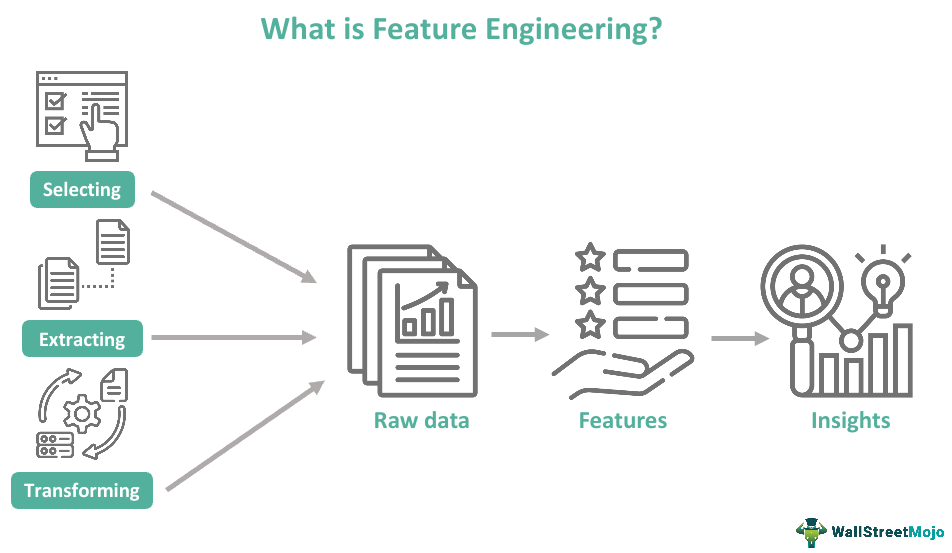
Think of raw data as ingredients in a kitchen. A machine learning algorithm is the recipe. But if your ingredients are unwashed, unchopped, and mismeasured, even the best recipe will produce a bad dish. Feature engineering is the prep work: cleaning, chopping, and combining ingredients so the "recipe" (your model) can do its best possible job.
In practical terms, this includes tasks like filling in missing values, converting text categories into numbers, scaling numeric ranges, combining two columns into a more meaningful one, and removing features that only add noise.
Why Feature Engineering Matters
Many beginners spend most of their time picking the "best" algorithm, assuming a fancier model will automatically perform better. In reality, the quality of your features usually has a bigger impact on accuracy than the choice of algorithm.
Good features also make your model easier to debug, explain to stakeholders, and maintain over time — which is exactly why every serious data science course spends real time on this skill.
The Feature Engineering Pipeline
Feature engineering doesn't happen in one step — it's a small pipeline within your larger machine learning workflow. Here's the typical flow you'll follow on almost every project:
Collect & Explore
Understand what each column means, check data types, and look for obvious issues before touching anything.
Clean
Handle missing values, fix inconsistent formats, and remove duplicate or corrupted records.
Transform & Create
Encode categories, scale numbers, and build new features that capture patterns the raw data hides.
Select & Validate
Keep only the features that genuinely help the model, and test the impact of each change.
Core Feature Engineering Techniques
These are the techniques you'll reach for again and again, regardless of the dataset or industry.
Handling Missing Values
Fill gaps using the mean, median, mode, or a predictive model — or create a flag column marking that a value was missing.
Encoding Categorical Data
Convert text categories like "Red", "Blue", "Green" into numbers using one-hot encoding, label encoding, or target encoding.
Feature Scaling
Normalize or standardize numeric columns so features with large ranges don't dominate features with small ranges.
Binning & Discretization
Group continuous values into ranges (e.g. "18–25", "26–35") to reveal patterns that raw numbers can hide.
Feature Creation
Combine existing columns — like turning "date of birth" into "age" — to create features that are more meaningful to the model.
Dimensionality Reduction
Use techniques like PCA to compress many correlated features into fewer, more informative ones.
Log & Power Transforms
Reduce skewness in numeric data (like income or sales) so models can learn patterns more reliably.
Feature Selection
Remove irrelevant or redundant features to reduce noise, speed up training, and prevent overfitting.
A Simple, Real Example
Let's say you're predicting whether a customer will churn, and your raw dataset looks like this:
| Customer | Signup Date | City | Monthly Spend |
|---|---|---|---|
| A | 2021-03-14 | Mumbai | ₹450 |
| B | 2019-11-02 | — | ₹1,200 |
| C | 2023-07-09 | Pune | ₹300 |
None of these columns are directly useful to a model as-is. Here's how feature engineering transforms them:
| New Feature | How It's Created |
|---|---|
| account_age_days | Today's date minus signup date |
| city_missing_flag | 1 if city is missing, else 0 |
| city_encoded | One-hot encoded city columns |
| spend_scaled | Monthly spend normalized between 0 and 1 |
Here's how that looks in Python using pandas:
# Convert signup date into a useful numeric feature
df['account_age_days'] = (pd.Timestamp.now() - df['signup_date']).dt.days

# Flag missing city values instead of just dropping them
df['city_missing_flag'] = df['city'].isnull().astype(int)
df['city'] = df['city'].fillna('unknown')

# One-hot encode the categorical column
df = pd.get_dummies(df, columns=['city'])

# Scale monthly spend between 0 and 1
from sklearn.preprocessing import MinMaxScaler
scaler = MinMaxScaler()
df['spend_scaled'] = scaler.fit_transform(df[['monthly_spend']])
Notice what happened: a raw date became a meaningful "account age," a missing value became useful information instead of a problem, and an unscaled number became model-friendly. This is feature engineering in action.
Common Mistakes Beginners Make
Dropping missing data too quickly
Deleting every row with a missing value can throw away useful information. Try imputing or flagging first.
Forgetting to scale features
Algorithms like KNN, SVM, and gradient descent-based models are sensitive to feature scale — skipping this step can hurt accuracy.
Leaking information from the target
Creating a feature that indirectly reveals the answer (data leakage) makes your model look great in testing and fail in production.
Creating too many features at once
More features isn't always better. Extra noisy features can confuse the model and slow down training.
Not validating feature impact
Always check whether a new feature actually improves your validation score before keeping it.
Tools & Libraries for Feature Engineering
You don't need to build everything from scratch. These are the most widely used tools in the industry:
Beginner Checklist
Before you train your next model, run through this quick checklist:
- Explored every column and understood what it actually means
- Handled missing values thoughtfully, not just by deleting rows
- Encoded all categorical columns into numeric form
- Scaled or normalized numeric features where needed
- Created at least one new feature from domain knowledge
- Checked for data leakage before finalizing features
- Validated that each new feature actually improves the model
Final Thoughts
Feature engineering is one of the highest-leverage skills you can learn in data science. It doesn't require advanced math or years of experience — just curiosity about your data and consistent practice with the techniques above. Start small: pick one dataset, apply these steps, and compare your model's performance before and after. You'll be surprised how much of a difference thoughtful features can make.
 Launch your Graphy