There are no items in your cart
Add More
Add More
| Item Details | Price | ||
|---|---|---|---|
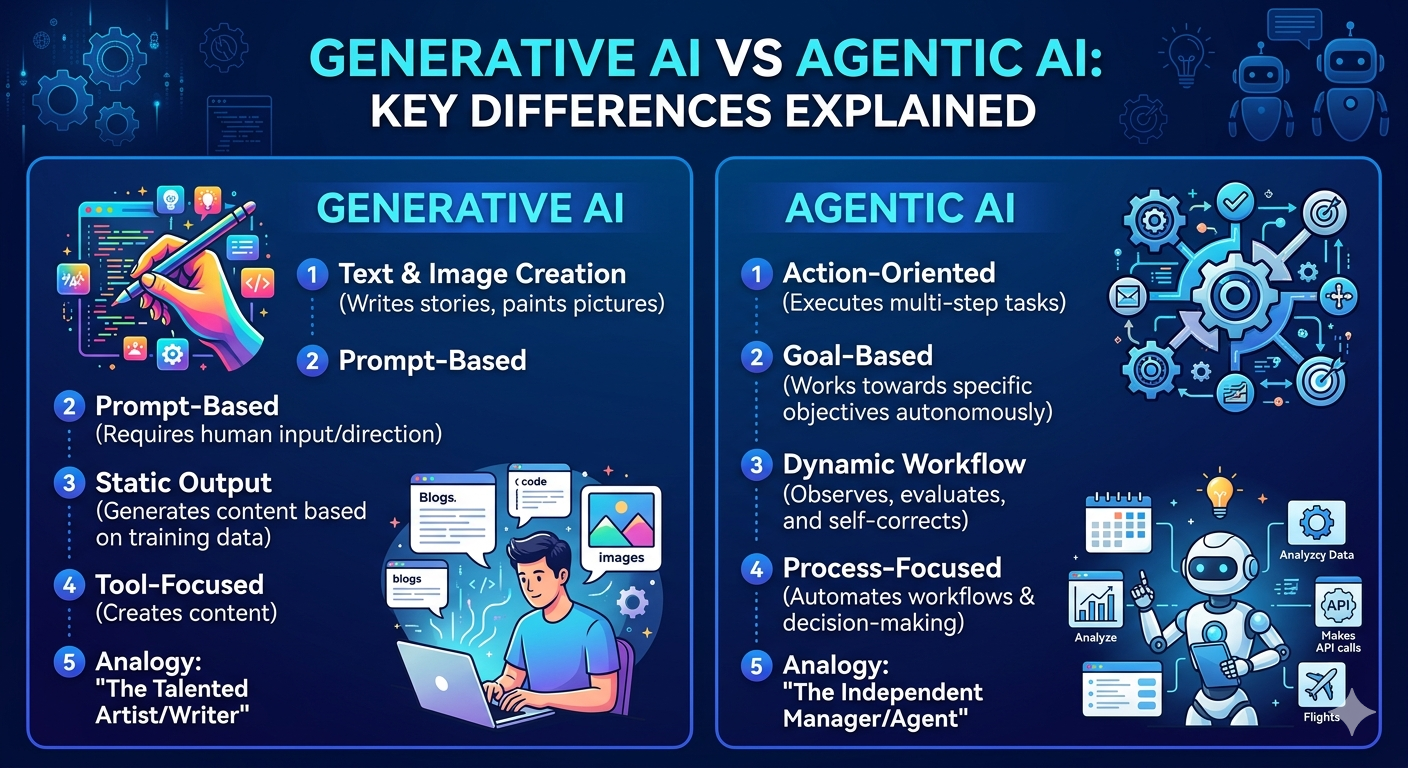
The primary difference between generative AI and agentic AI lies in autonomy and execution. Generative AI creates content—such as text, code, or images—based on direct user prompts in a stateless manner. In contrast, Agentic AI operates autonomously, breaking down high-level goals into multi-step tasks, utilizing external tools, and executing actions to achieve specific outcomes.
For students and professionals, understanding both technologies is essential. Generative AI is valuable for writing, learning, coding, and creativity, whereas Agentic AI is becoming crucial for automation, productivity, and business operations. The future of AI will combine both capabilities, where AI systems can generate content and independently execute tasks.
Generative AI (Artificial Intelligence) is a type of AI that can create new content such as text, images, videos, music, code, and designs based on the data it has learned from. Instead of simply analyzing information, Generative AI generates original outputs in response to user prompts.
when you ask an AI tool to write a blog, create a logo, generate an image, or write computer code, it uses patterns learned from large datasets to produce new content. Popular Generative AI tools include ChatGPT, Gemini, Claude, and Midjourney.
While exceptionally powerful for ideation and boilerplate generation, standard generative AI exhibits several critical limitations in production environments:
Generative AI is trained on massive amounts of data, including books, articles, websites, images, and code. It learns patterns, relationships, and structures from this data. When a user provides a prompt, the AI predicts and generates the most relevant response based on its training.
Agentic AI is an advanced form of Artificial Intelligence that can understand goals, make decisions, plan actions, use tools, and complete tasks with minimal human intervention. Unlike traditional AI systems that simply respond to prompts, Agentic AI can take initiative and work toward achieving a specific objective.
Instead of waiting for a human to prompt every step, an agentic AI is given a high-level goal. It then initiates an internal loop of reasoning and acting, often querying external databases, executing code, or communicating with other APIs until the goal is met or an exit condition is triggered.
To build an agentic system, engineers wrap an LLM in a cognitive architecture. The most common framework for this is ReAct (Reasoning and Acting). A robust AI agent consists of four primary components:
1. Goal Understanding
2. Planning
3. Tool Usage
4. Decision Making
5. Continuous Execution
| Architectural Feature | Generative AI |
Agentic AI |
| Primary Objective | Content creation (text, code, media) based on direct input. | Task execution and multi-step goal achievement. |
| Execution Flow | Single-turn, request-and-response (Stateless). | Continuous evaluation loops (Stateful, while-loops). |
| Environment Interaction | Isolated. Cannot affect external systems. | Active. Can execute APIs, query databases, and write files. |
| Error Handling | Relies on human user to read the output, detect errors, and re-prompt. | Capable of autonomous self-correction by analyzing error stack traces and retrying. |
| Cognitive Approach | Direct sequence generation. | Chain-of-Thought (CoT), Tree of Thoughts (ToT), and ReAct reasoning. |
| System Complexity | Low. Usually a single API endpoint integration. |
High. Requires orchestration frameworks (LangChain, AutoGen) and sandbox environments. |
The theoretical difference between generative ai and agentic ai manifests distinctly in enterprise applications. Choosing the correct paradigm ensures cost efficiency and system reliability.
Generative AI is optimal for tasks that require pattern matching, creative synthesis, and semantic transformations where human review is the final step.
Agentic AI is utilized for complex, multi-step engineering operations where the AI must safely modify states, interact with environments, and validate its own work.
kubectl commands.For software architects, deciding whether to implement a generative endpoint or a full agentic system comes down to evaluating task complexity, determinism, and computational overhead.
Choose Generative AI when:
 Launch your Graphy