

There are no items in your cart
Add More
Add More
| Item Details | Price | ||
|---|---|---|---|

Every search, every AI query, every cloud upload consumes energy. Green Computing is the practice of designing, using, and disposing of technology in ways that minimize environmental impact — without slowing down innovation
|By Affordable AI, Nagpur
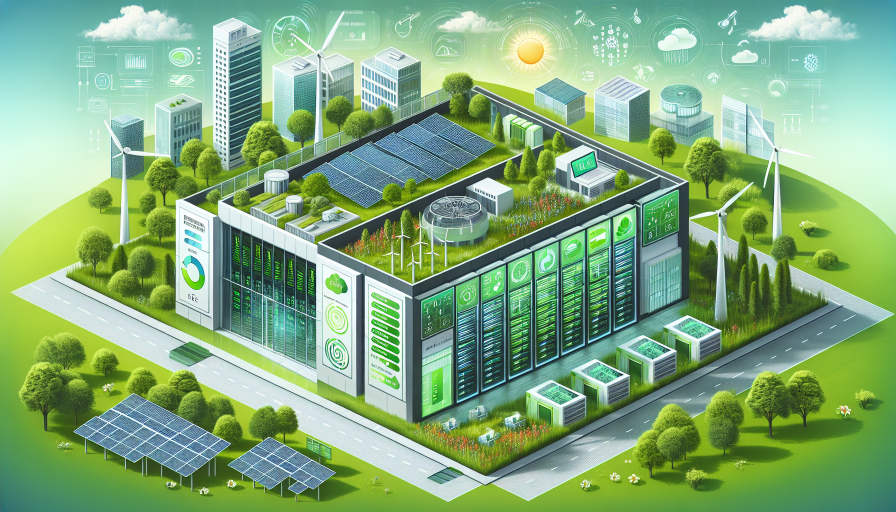
Technology powers modern life — but it also has an environmental cost. From the servers that run our cloud apps to the laptops on our desks, digital infrastructure now accounts for a significant and fast-growing share of global electricity use and electronic waste. Green Computing (also called Green IT or Sustainable Computing) is the discipline of designing hardware, writing software, and operating IT systems in ways that reduce energy consumption, carbon emissions, and electronic waste — while maintaining performance and reliability.
In this guide, we break down the core technical pillars of green computing, how data centers are becoming more efficient, how developers can write energy-conscious code, and what the future holds for sustainable IT.
The global IT sector is estimated to contribute between 2–4% of total greenhouse gas emissions — a figure comparable to the aviation industry. As AI, cloud computing, and IoT devices scale, energy demand from data centers is projected to double within the next decade.
A technical breakdown of where sustainability efforts are concentrated across the IT stack.
Low-power CPUs, ARM-based chips, solid-state drives, and Energy Star-certified devices that deliver more computation per watt.
Running multiple virtual machines on one physical server drastically reduces idle hardware and improves resource utilization.
Writing efficient algorithms, reducing computational complexity, and minimizing unnecessary background processes to cut power draw.
Refurbishing, recycling, and responsibly disposing of electronics to recover rare-earth materials and reduce landfill waste.
Shifting data centers and offices to solar, wind, and hydro power to reduce dependence on fossil-fuel grids.
Dynamic voltage scaling, sleep states, and AI-driven workload scheduling that match power usage to actual demand.
Data center efficiency is measured using PUE (Power Usage Effectiveness) — the ratio of total facility energy to energy used by IT equipment. A PUE of 1.0 would mean perfect efficiency (no overhead), while older facilities often run at 2.0 or higher.
| Cooling Method | Efficiency Gain |
| Free-air cooling | Up to 30% |
| Liquid immersion cooling | Up to 45% |
| AI-optimized thermal control | Up to 40% |
Software efficiency directly impacts hardware energy draw. Small algorithmic changes at scale create massive energy savings.
Optimizing an O(n²) algorithm to O(n log n) can cut CPU cycles dramatically at scale.
Choosing the right structure reduces memory allocation and processing overhead.
Load only what's needed, when it's needed — reducing unnecessary compute and bandwidth.
Run non-urgent batch jobs when the power grid is running on cleaner energy sources.
Electronic waste is the world's fastest-growing waste stream. Less than 20% of global e-waste is formally recycled, meaning valuable materials like gold, copper, and rare-earth elements are lost — while toxic substances like lead and mercury contaminate soil and water.
Enable power-saving/sleep modes, extend device lifespan, buy refurbished hardware, and recycle old electronics responsibly.
Profile and optimize code, minimize redundant API calls, compress assets, and choose energy-efficient cloud regions.
Adopt server virtualization, migrate to green-certified cloud providers, and implement IT asset lifecycle management.
Emerging technologies like neuromorphic chips, quantum computing, and carbon-aware AI scheduling promise to reduce compute-per-task energy costs even further. As AI adoption grows, the industry faces a critical balancing act — scaling intelligence while shrinking its environmental footprint. Organizations that build sustainability into their tech stack today will be best positioned for the regulatory and cost pressures of tomorrow
 Launch your Graphy