There are no items in your cart
Add More
Add More
| Item Details | Price | ||
|---|---|---|---|
BY - Affordable AI Nagpur
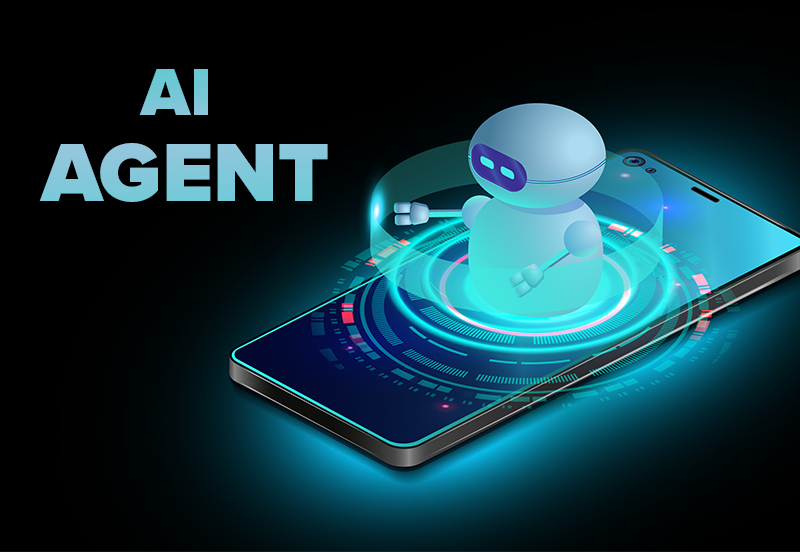
A few years ago, "AI at work" mostly meant autocomplete — a chatbot answering questions, a model suggesting the next word in an email. That's no longer the whole picture. A new category of tool, the AI agent, doesn't just respond to a single prompt. It plans, takes actions, uses other software, checks its own results, and keeps going until a task is actually done.
That shift — from answering questions to completing work — is what's quietly reshaping how teams operate.
A traditional AI assistant is reactive: you ask, it answers, the interaction ends. An agent is built to operate in a loop:
1. Understand the goal — not just a single question, but a multi-step objective
2. Break it into steps — plan a sequence of actions needed to get there
3. Use tools — search the web, run code, query a database, send an email, edit a file
4. Check its own work — review output, catch errors, retry if something fails
5. Keep going — continue across many steps without a human re-prompting at every turn
The practical difference is significant. Asking a chatbot "how do I fix this bug" gets you an explanation. Pointing an agent at a codebase and asking it to fix the bug gets you a working pull request — the agent reads the code, makes the change, runs the tests, and reports back.
Software Development
This is the area where agentic tools have matured fastest. Coding agents can read an entire codebase, implement a feature across multiple files, run the test suite, and iterate on failures — largely unsupervised for stretches of time. Developers increasingly act as reviewers and directors rather than writing every line themselves.
Customer Support
Instead of a scripted chatbot limited to FAQ answers, support agents can look up an order, issue a refund through an internal system, escalate to a human when a policy decision is needed, and follow up automatically. The agent isn't just answering — it's completing the transaction.
Research and Analysis
Agents can run a multi-step research process: search multiple sources, cross-check facts, pull data from spreadsheets or internal documents, and assemble a structured report — work that used to take an analyst hours of manual searching and synthesis.
Operations and Back-Office Work
Repetitive, rules-based processes — invoice reconciliation, data entry across systems, scheduling, basic compliance checks — are well suited to agents that can navigate multiple internal tools the way a human would, rather than relying on rigid, pre-built integrations.
Personal Productivity
On an individual level, agents are starting to handle inbox triage, calendar coordination, document drafting, and meeting follow-ups — chaining several small actions together instead of requiring a person to do each one manually.
Earlier automation (think RPA — robotic process automation) worked by following rigid, pre-programmed rules: click here, copy this field, paste it there. It broke the moment a workflow changed even slightly.
Agents built on large language models are more flexible. They can interpret ambiguous instructions, adapt when a website's layout changes, handle exceptions, and reason about why a step failed rather than just halting. That flexibility is what lets them tackle messier, less predictable work than traditional automation ever could.
The conversation about AI agents and jobs tends to polarize quickly, but the more grounded picture is one of role transformation rather than wholesale replacement — at least so far.
It's worth being honest about the uncertainty here: predictions about automation's exact pace and scale have historically been wrong in both directions, and the same caution applies now
Adopting agents isn't just a technical upgrade — it raises real operational questions:
Companies that treat this purely as a cost-cutting exercise tend to see worse outcomes than those that treat it as a redesign of how work gets done, with people repositioned toward higher-judgment tasks.
A few practical takeaways for anyone navigating this shift:
AI agents aren't a single product — they're a shift in how software relates to work itself: from tools that wait for instructions to systems that pursue goals. The technology is still maturing, and plenty of agent deployments today are clumsy or over-hyped. But the trajectory is clear enough that "how do I work with an agent" is becoming a more useful question than "will an agent take my job."
 Launch your Graphy