There are no items in your cart
Add More
Add More
| Item Details | Price | ||
|---|---|---|---|
Two of the world's most in-demand languages, one decision to make. Here's an honest, practical comparison to help you choose the right starting point for your coding journey — no hype, just what actually matters for beginners.
| By Affordable AI, Nagpur
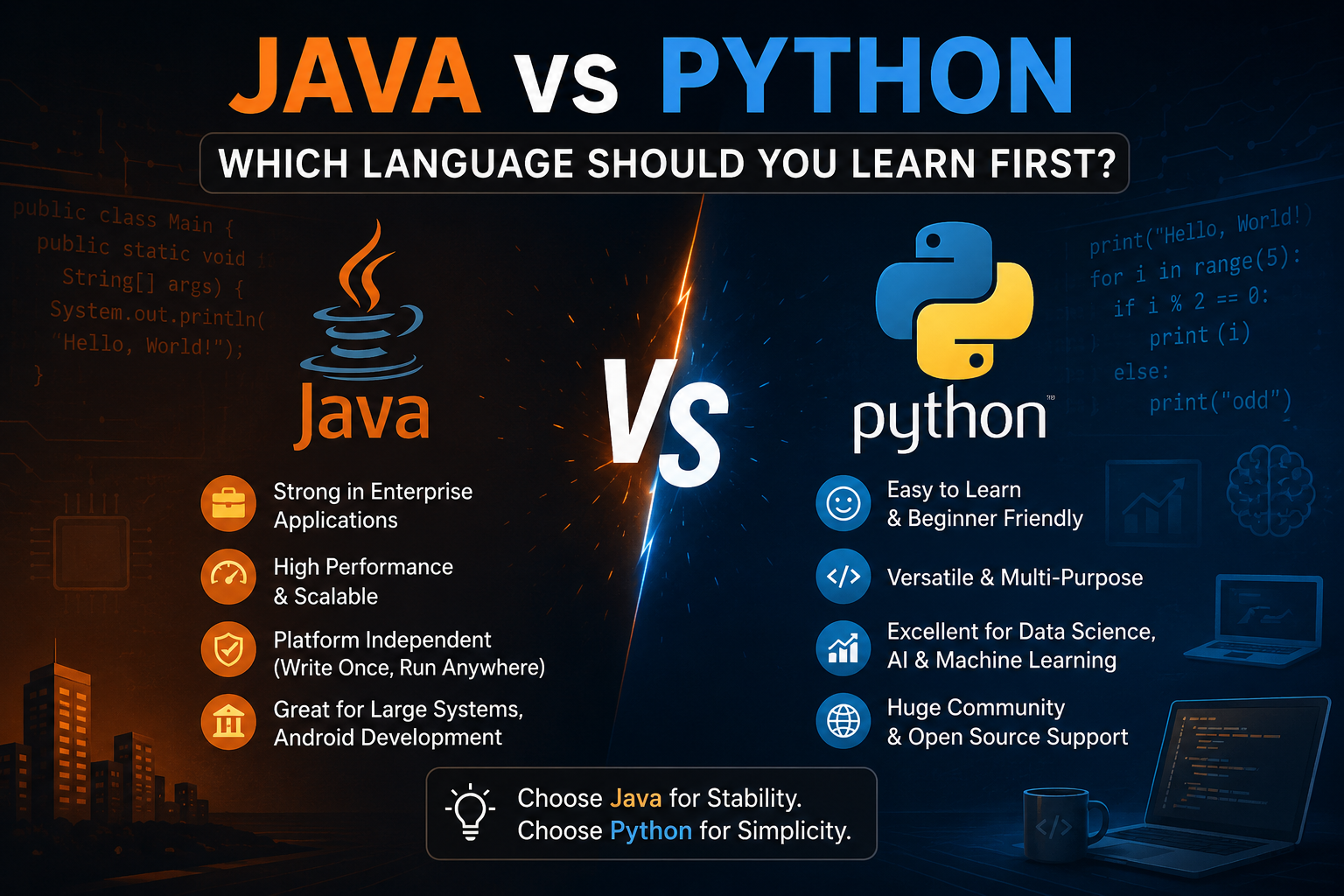
If you've searched "which programming language should I learn first," you've probably landed on a dozen conflicting opinions. Some swear by Python's simplicity. Others insist Java builds "real" programmers. The truth is less dramatic: both are excellent first languages, and the right one depends entirely on what you want to build and where you want to work.
Instead of picking a side, this guide breaks down exactly how Java and Python differ — in syntax, speed, career outcomes, and learning curve — so you can make a decision based on facts, not internet arguments.
Before comparing them, let's understand what each language was built for.
Created in 1991 by Guido van Rossum, Python was designed around one core idea: code should be easy to read, almost like plain English. It's a dynamically typed, interpreted language that lets you write powerful programs in far fewer lines than most other languages.
Released in 1995 by Sun Microsystems, Java was built on the principle of "write once, run anywhere." It's a statically typed, compiled language known for strict structure, strong performance, and long-term reliability in large systems.
A side-by-side look at the factors that actually matter when choosing your first language.
| Factor | Python | Java | Edge |
|---|---|---|---|
| Learning curve | Simple, English-like syntax | More verbose, strict rules | Python |
| Typing system | Dynamically typed | Statically typed | Java |
| Execution speed | Slower (interpreted) | Faster (compiled to bytecode) | Java |
| Best for | AI, ML, data science, scripting, automation | Android apps, enterprise software, backend systems | Depends on goal |
| Job openings (entry-level) | Very high, growing fast | Very high, stable demand | Tie |
| Community & resources | Massive, beginner-friendly | Massive, enterprise-focused | Tie |
| Error handling for beginners | Forgiving, quick feedback loop | Stricter, catches errors before running | Java (long-term discipline) |
| Time to build first project | Days | 1–2 weeks | Python |
Nothing explains the difference better than actual code. Here's how each language handles a simple task: printing numbers 1 to 5.
for i in range(1, 6):
print(i)public class Main {
public static void main(String[] args) {
for (int i = 1; i <= 5; i++) {
System.out.println(i);
}
}
}Notice the difference? Python needs 2 lines. Java needs a full class structure, a method declaration, and explicit type definitions just to print five numbers. This is exactly why beginners often find Python less intimidating on day one — but that same structure is also what makes Java such a strong foundation for large-scale software.
Beginner-friendly syntax, fastest-growing language for AI/ML, huge open-source library support, great for quick prototyping and automation scripts.
Slower execution speed, not ideal for mobile app development, dynamic typing can hide bugs until runtime in larger projects.
Excellent performance, platform independence, strong typing catches errors early, industry standard for Android and enterprise backend systems.
More boilerplate code, steeper initial learning curve, slower to prototype simple ideas compared to Python.
Python is the undisputed leader — TensorFlow, PyTorch, and scikit-learn are all Python-first.
Pandas, NumPy, and Jupyter Notebooks make Python the standard for data analysis and visualization.
Quick scripts to automate repetitive tasks, web scraping, and testing are almost always written in Python.
Java (alongside Kotlin) remains a core language for building native Android applications.
Banks, insurance companies, and large corporations rely heavily on Java for stable, long-running backend systems.
Frameworks like Spring Boot make Java a top choice for scalable, high-traffic backend services.
Forget generic advice. Find the description closest to your situation below.
You want a gentle introduction without getting stuck on syntax errors for hours.
Learn Python firstNearly every AI course, tool, and job posting in this field expects Python knowledge.
Learn Python firstJava gives you a direct path into native Android development and mobile engineering roles.
Learn Java firstLarge enterprises, banks, and MNCs run heavily on Java-based systems and hire accordingly.
Learn Java firstGreat goal — many professional developers know both. Start with Python to build confidence, then move to Java to strengthen your fundamentals.
Start with PythonBoth languages offer strong entry-level demand. Pick based on which sample code above felt more comfortable to you.
Either worksWhichever language you pick, here's a realistic path to writing your first real project.
Variables, data types, loops, conditionals, and functions. Focus on writing small, working programs daily.
Lists/arrays, dictionaries/maps, and basic object-oriented programming concepts (classes and objects).
A calculator, a to-do list, or a simple data analysis script — apply what you've learned to something real.
If Python: start exploring Pandas or a basic ML tutorial. If Java: start learning Android basics or Spring Boot fundamentals.
Generally, yes. Python's syntax is closer to plain English and requires less boilerplate code, which makes it easier to see quick results and stay motivated in the early stages of learning.
Salaries for both are broadly comparable at the entry level and depend more on your role, company, and location than the language itself. Python often has an edge in AI/ML-specialized roles, while Java remains strong in enterprise and backend-heavy positions.
Absolutely. Once you understand core programming concepts like loops, functions, and object-oriented design in one language, picking up a second language becomes significantly faster.
Java is still widely used for Android, though Kotlin has become Google's preferred language for new Android projects. Learning Java first still gives you a strong foundation for either.
Python is the essential starting point, but most AI roles also expect knowledge of libraries like NumPy, Pandas, and a machine learning framework such as TensorFlow or PyTorch, along with core math and statistics fundamentals.
Both Java and Python can lead to rewarding, well-paying careers in tech. The biggest mistake isn't picking the "wrong" language — it's spending months deciding instead of writing your first line of code. If you're drawn to AI, automation, or data, start with Python. If you're excited about building apps or working in large-scale enterprise systems, start with Java. Either way, consistency over the next few months will matter far more than which language you started with.
Explore beginner-friendly Python, Java, and AI courses designed to take you from zero to job-ready — at a price that actually makes sense.
 Launch your Graphy