There are no items in your cart
Add More
Add More
| Item Details | Price | ||
|---|---|---|---|

BY - Affordable AI Nagpur
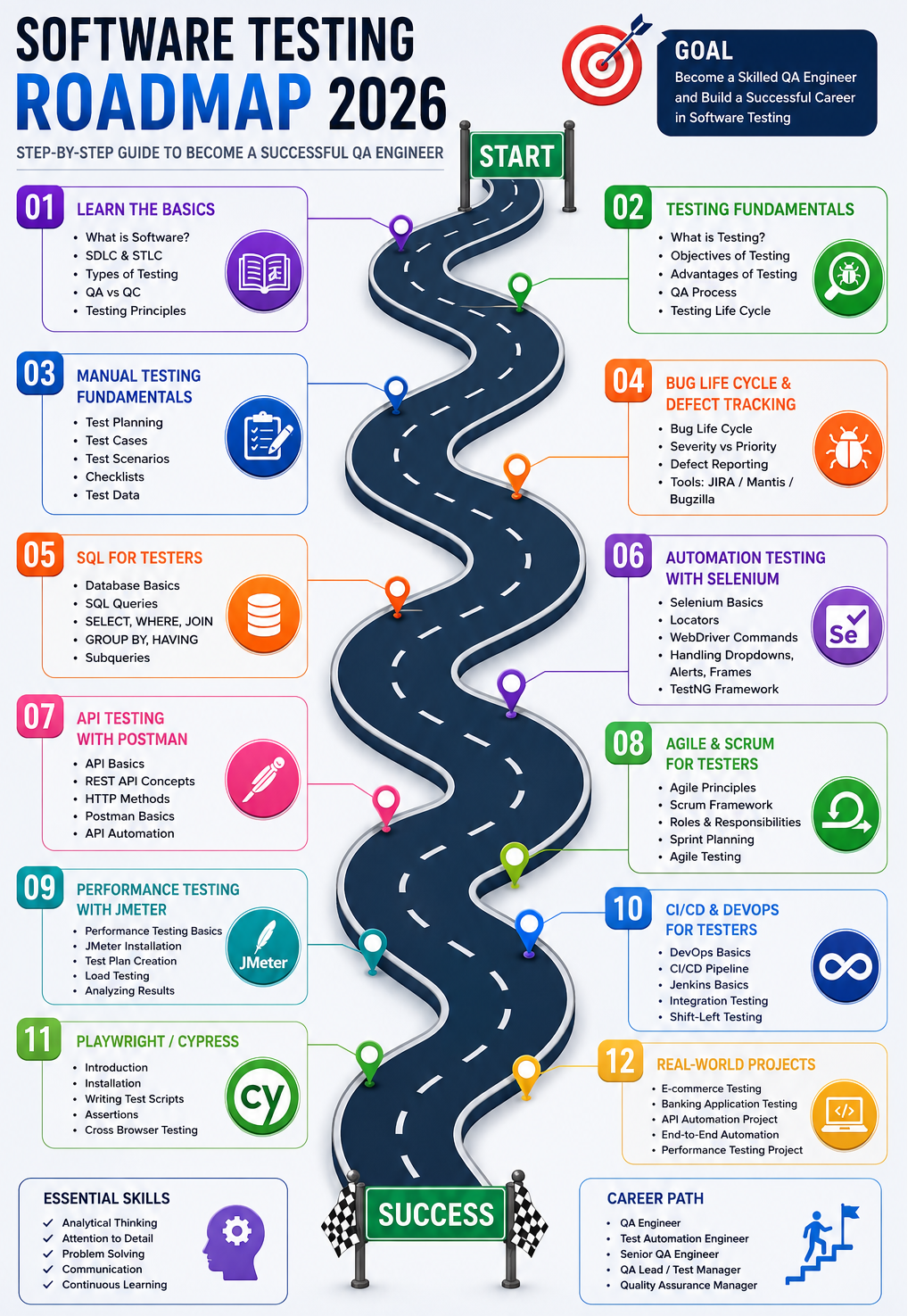
Software touches almost everything we do — banking, healthcare, shopping, communication. Behind every reliable app is a team of people whose job is to break things on purpose, before users do it by accident. That's software testing, and it's one of the more accessible and stable entry points into tech.
This guide walks through a complete path: starting with manual testing fundamentals, moving into automation, branching into specialized testing domains, and finally connecting it all to modern DevOps practices
Software testing is the process of verifying that an application behaves the way it's supposed to. It's a bit like a pre-flight inspection: you check the obvious things (does the button work?) and the less obvious things (what happens if 10,000 people click it at once?).
Testing generally splits into two broad categories:
A bug in a to-do list app is an inconvenience. A bug in a payment system or a medical device can be a serious problem. That's why testers are often described as the last checkpoint between a flawed build and a real user
Everyone in QA starts here, regardless of where they end up.
SDLC and STLC
The Software Development Lifecycle (SDLC) is the overall journey of a product from idea to release. Nested inside it is the Software Testing Lifecycle (STLC) — the specific steps testers follow:
1. Requirement analysis — understanding what needs to be tested
2. Test planning — deciding strategy, tools, and ownership
3. Test case development — writing out the steps and expected outcomes
4. Environment setup — preparing the systems tests will run on
5. Test execution — actually running the tests
6. Test closure — reporting results and capturing lessons learned
A test case is a simple, repeatable set of instructions: do X, expect Y. To avoid testing every possible input (which is often impossible), testers rely on a few core techniques:
Black box testing evaluates the app purely from the outside — inputs in, outputs out — without looking at the underlying code. It's usually where beginners start. White box testing goes deeper, examining the code itself to confirm internal logic is sound; this is more common among developers and senior testers. A well-rounded tester eventually understands both
Finding a bug is only step one. Every defect moves through a lifecycle: New → Assigned → Fixed → Verified → Closed. Tools like Jira are the industry standard for tracking this. A strong bug report typically includes:
Testing today rarely happens only "at the end." In Agile teams, testing is continuous, woven into short cycles called sprints (commonly two weeks). Testers participate in daily standups, sprint planning, and sprint reviews alongside developers and product owners. Comfort with this collaborative, iterative rhythm matters as much as any specific tool.
Once the fundamentals are solid, the next step is teaching a machine to run repetitive checks for you.
Pick a Language
Java and Python dominate this space. Java is common in large enterprises thanks to its maturity and ecosystem of testing tools. Python tends to be the easier on-ramp for beginners because of its readable syntax. You don't need to become a full-time developer — just comfortable enough to write and maintain test scripts.
Selenium WebDriver
Selenium is the most widely used tool for automating web browsers — it can open pages, click buttons, fill forms, and verify results, just like a human would, but at machine speed. Learning to locate page elements and drive a browser programmatically is usually the first real "aha" moment in an automation journey.
Test Frameworks
Running one script is easy. Running hundreds in an organized, repeatable way needs a framework:
These frameworks add structure through assertions (automatically checking actual vs. expected results), parallel execution (running many tests simultaneously), and data-driven testing (running the same test logic across multiple data sets).
Page Object Model
As test suites grow, code can become fragile — one UI change can break dozens of scripts. The Page Object Model (POM) solves this by organizing code into one file per page, so a single UI change only requires a single code update. This kind of design thinking is what separates a script-writer from someone building a maintainable automation framework — a core skill for the SDET (Software Development Engineer in Test) role.
With core automation skills in place, testers often branch into specialty areas.
API Testing
Not all testing happens on a visible screen. Applications constantly talk to each other behind the scenes — a travel app pulling flight prices from an airline, for instance. Postman is the standard tool for manual API testing, while RestAssured handles automated API checks in code. API testing tends to be faster and more stable than UI testing, since it catches logic errors before they ever reach the interface.
Performance Testing
What happens when a million people hit the app at once? Performance testing answers that, using tools like JMeter or k6 to simulate heavy load and measure response times, server resource use, and breaking points. This is non-functional testing at its most data driven — useful for anyone who enjoys analytics and systems thinking.
Mobile Testing
With most users on phones rather than desktops, mobile testing has its own quirks: touch gestures, battery drain, varying network conditions, device fragmentation. Appium is the leading tool for automating both Android and iOS apps, making it a valuable skill as companies lean further into mobile-first design.
Security Testing Basics
You don't need to be a penetration tester to add real value here. Understanding common vulnerabilities — weak authentication, exposed sensitive data, basic input validation gaps — gives a QA engineer the ability to catch serious issues early. For those who want to go deeper, security testing is one of the higher-paid specializations in the field.
CI/CD Integration
Modern teams ship updates constantly, sometimes multiple times a day. Continuous Integration / Continuous Deployment (CI/CD) automates the testing process so that every code change is automatically verified before it reaches users. Tools like Jenkins and GitHub Actions trigger test suites automatically whenever new code is pushed — turning testing from a manual gate into a built-in safety net.
Docker for Test Environments
"It works on my machine" is a problem as old as software itself. Docker packages an entire test environment — code, dependencies, configuration — into a portable container that behaves identically everywhere it runs. This makes it possible to spin up a clean test environment in seconds, which is essential at enterprise scale.
| Stage |
Focus |
| Manual QA Tester |
Learning the app, writing test cases, finding bugs by hand |
| Automation Engineer / SDET | Building and maintaining automated test systems |
| QA Lead | Guiding a small team, shaping test strategy |
| QA Manager | Owning quality across an entire product or organization, including hiring and budget |
There's no single "correct" path — some testers stay deeply technical as senior SDETs, others move toward leadership. Both are valid, well-compensated directions.
Is software testing a good career choice right now? Yes. As companies treat product quality as a competitive advantage, demand for skilled testers has stayed strong, with clear growth paths into automation, specialization, or leadership.
How long does it take to become a software tester? Most people can build foundational manual testing skills in a few months. Adding automation typically takes a few more months of consistent practice. Total time to job-readiness is often in the 3–6 month range, depending on prior experience and effort.
Can I get into testing without knowing how to code? Yes. Manual testing doesn't require programming — it leans on logic, attention to detail, and understanding user experience. Coding becomes more important if you want to move into automation, which usually comes with a pay bump.
What's the real difference between manual and automation testing? Manual testing relies on a human's judgment — great for exploratory testing, usability checks, and catching things a script wouldn't think to look for. Automation testing relies on scripts to run repetitive checks quickly and consistently. Strong testers know when to use each.
What exactly is an SDET, and how does it differ from QA? An SDET (Software Development Engineer in Test) blends testing expertise with serious software engineering — building the tools and frameworks that power testing at scale, rather than just writing individual test cases. It's generally considered a senior, specialized role within the broader QA career path.
 Launch your Graphy