There are no items in your cart
Add More
Add More
| Item Details | Price | ||
|---|---|---|---|

Two data points walk into an algorithm. One knows the answer already, the other has to find the pattern on its own. That's the entire difference — and it changes everything about how machine learning actually works.
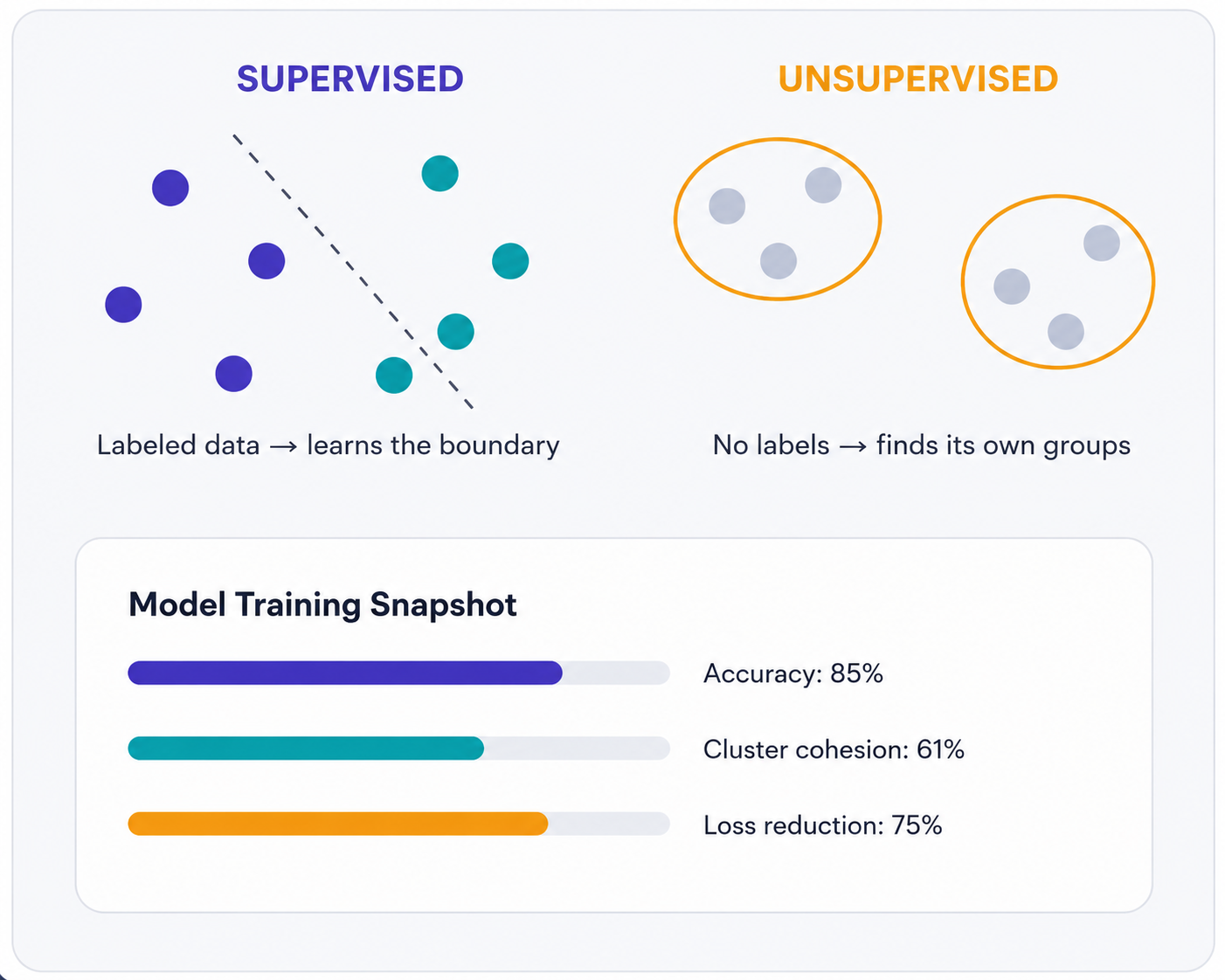
Almost every machine learning model you'll ever build, use, or read about falls into one of two broad families: supervised learning and unsupervised learning. Understanding the difference isn't just academic — it determines what kind of data you need, what problems you can solve, and how you'll judge whether your model actually works.
Think of it this way: a supervised model is a student learning with an answer key, checking every practice question against the correct response until the pattern sinks in. An unsupervised model is a student handed a pile of unsorted notes, left to organize them into categories based on similarity alone, with no teacher confirming right or wrong. Both are valid ways to learn — they're just suited to very different classrooms.

Both learning types ultimately aim to turn raw data into usable insight — they just take opposite paths to get there.
Before the algorithms and the math, it helps to understand the mindset behind each approach.
The algorithm learns from labeled data — every training example comes with the correct answer attached. The model's job is to find the relationship between inputs and outputs so it can predict the label for data it has never seen.
Goal: Predict a known outcome
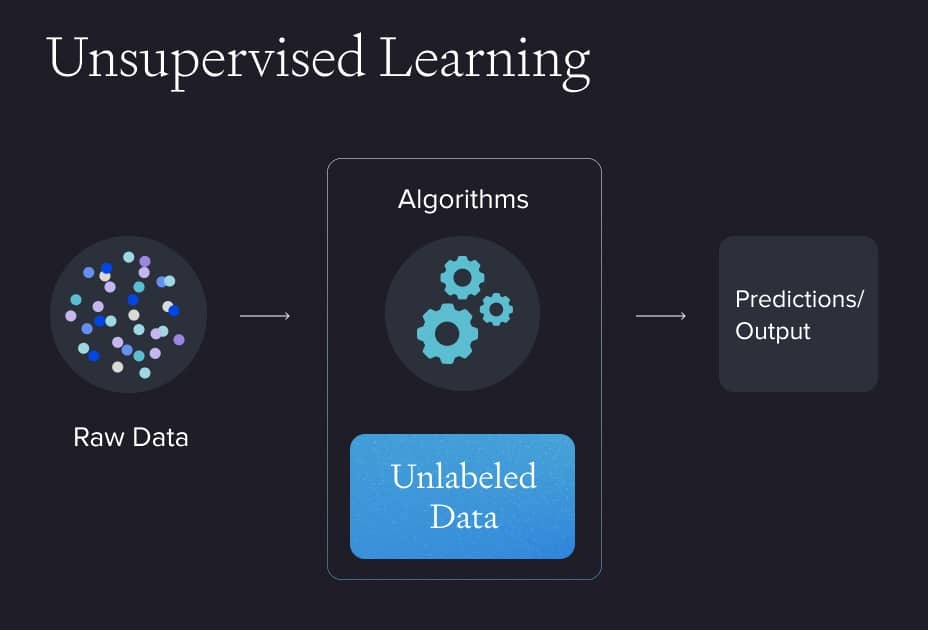
The algorithm works with unlabeled data — there's no correct answer given. Instead, it searches for hidden structure, natural groupings, or patterns that a human hasn't already defined.
Goal: Discover a hidden structure
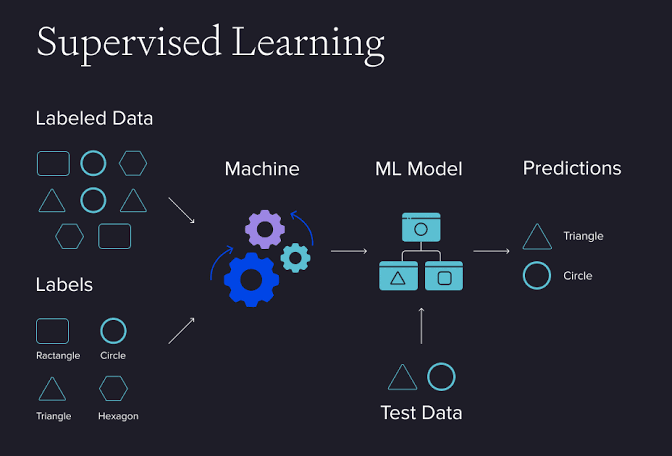
In supervised learning, you feed the algorithm a dataset where every input already has a known, correct output — like thousands of emails already tagged "spam" or "not spam." The model makes a prediction, compares it to the true label, calculates how wrong it was, and adjusts itself to do better next time. Repeat this thousands of times, and the model gets progressively sharper at mapping new, unseen inputs to the right output.
Supervised learning splits into two main problem types:
Predicts a numeric value by fitting the best straight-line relationship between inputs and output.
A go-to for binary classification problems like fraud detection or churn prediction.
Splits data through a series of yes/no questions to reach a prediction — easy to visualize and explain.
Combines many decision trees to produce a more accurate, stable prediction than any single tree.
Finds the optimal boundary that separates classes with the widest possible margin.
Layered networks of artificial neurons capable of learning highly complex, non-linear patterns.
Unsupervised learning gets no answer key. Instead, the algorithm examines the raw structure of the data itself — how points cluster together, which features move together, which ones stand apart — and organizes the data based purely on similarity and pattern. There's no "correct" output to check against, which makes evaluation trickier, but it also means unsupervised learning can uncover patterns a human wouldn't have thought to look for.
Unsupervised learning generally covers three problem types:
Groups data into a set number of clusters based on distance from each cluster's center point.
Builds a tree of nested clusters, useful when you don't know how many groups to expect.
Groups points based on density, and is especially good at spotting outliers and irregular shapes.
Principal Component Analysis reduces high-dimensional data down to its most informative dimensions.
Identifies frequent itemsets in transactional data — the backbone of market basket analysis.
Neural networks that compress and reconstruct data, useful for anomaly detection and denoising.
| Aspect | Supervised Learning | Unsupervised Learning |
|---|---|---|
| Input Data | Labeled (input + correct output) | Unlabeled (input only) |
| Main Goal | Predict an outcome or category | Discover hidden patterns or structure |
| Common Tasks | Classification, Regression | Clustering, Association, Dimensionality Reduction |
| Evaluation | Straightforward — compare predictions to true labels | Harder — no ground truth to check against |
| Data Prep Cost | Higher — labeling data is time-consuming | Lower — raw data can be used directly |
| Example Use Case | Predicting whether a loan applicant will default | Segmenting customers by shopping behavior |
Most industries lean on both types of learning — often for very different parts of the same problem.
Supervised: Diagnosing disease from labeled scans.
Unsupervised: Discovering new patient risk groups.
Supervised: Predicting loan default risk.
Unsupervised: Detecting unusual, potentially fraudulent transactions.
Supervised: Forecasting product demand.
Unsupervised: Grouping shoppers into segments for targeted offers.
Supervised: Predicting which users will click an ad.
Unsupervised: Finding topic clusters in customer feedback.
Supervised and unsupervised learning aren't competitors — they're two complementary tools in every data scientist's toolkit. Supervised learning shines when you know exactly what you're trying to predict and have the labeled data to prove it. Unsupervised learning shines when you're exploring the unknown, letting the data reveal structure you didn't know was there. Most real-world AI systems, from recommendation engines to fraud detection pipelines, actually combine both.
Mastering the difference between the two isn't just theory — it's the foundation every other machine learning concept builds on, from reinforcement learning to deep learning architectures.
Explore beginner-friendly, affordable AI and Machine Learning courses built to take you from fundamentals like this to building real projects.
Explore Courses on AffordableAI → Launch your Graphy